|
Let’s take away what matters in AI every day and stay ahead with 50,000⁺ founders, builders, and tech readers.
|
|
|
BIG TECHAWAYS
STORIES THAT MATTER TODAY
Anthropic launched Claude Tag, a beta that brings Claude Enterprise and Team into Slack. Teams can now tag @Claude directly in a channel, assign work, let it use selected tools, preserve channel context, and give admins logs, spend controls, and access controls.
That matters because the agent is no longer just a private chat between one person and a model. Claude Tag puts AI where team work already happens: channels, threads, context, reviewers, permissions, and action history.
The visible part is @Claude in Slack. The more important layer sits underneath: orchestration tight enough for AI to operate in team context, use tools, retain memory, pass through permissions, and leave a trail humans can inspect. If this pattern works, the enterprise agent interface may look surprisingly ordinary: not a shiny new app, but a teammate tagged inside the workflow people already use.
The Wall Street Journal reported that Masayoshi Son told SoftBank shareholders he wants to grow SoftBank Group's net asset value to $6.189 trillion within roughly a decade, based on the promise of artificial superintelligence.
The number is a signal for how capital markets are now telling the AI story. AI is no longer only a thesis for a startup, a new model, or a software layer. It is being used to justify valuation ambition at the holding-company level.
OpenAI says it has joined the creation of the Appia Foundation, hosted by the Linux Foundation, to develop open and modular specifications for advanced AI evaluation. The goal is to turn broad AI frameworks and standards into more concrete assessment criteria.
This is the less glamorous layer, but it is becoming more necessary. As AI moves into real workflows, the question is not only how strong a model is. Enterprises, governments, vendors, auditors, and users need a shared way to show how a system was evaluated.
|
|
|
SHIFT SIGNALS
BEHIND THE HEADLINES
- AI coding becomes software diligence: Rohan Paul says Bain is experimenting with vibe coding to build rough clones of software during takeover diligence. If that holds, AI coding is not just about shipping products faster; it becomes a way to test the moat of a software business.
- Mistral upgrades document ingestion: Mistral AI introduced OCR 4, with bounding boxes, block classification, inline confidence scores, and support for 170 languages. For agents and search systems, better ingestion is real infrastructure: a model struggles to reason well when the input document is structurally wrong.
- OpenAI invests in the OSS layer: OpenAI Developers says OpenAI has directly funded maintainers, invested in the Rust ecosystem, launched Patch the Planet, and expanded Codex for OSS. AI labs are starting to support the open-source dependency layer their own toolchains rely on.
- Banned Nvidia chips get pricier in China: The Financial Times reported that banned Nvidia AI chips have more than doubled in price on China's black market. Export controls do not make demand for compute disappear; they can turn compute into a scarcer, more expensive, and harder-to-track asset.
- Recursive self-improvement becomes a watch item: Kimmonismus says Anthropic's Jack Clark believes recursive self-improvement could appear by 2028. Treat this as a watch item rather than a settled conclusion, but it helps explain why labs are paying more attention to research automation, governance, and AI's role in creating the next generation of AI.
- Omio turns AI into a travel interface: OpenAI wrote about Omio, the travel company using ChatGPT, Codex, and the API to build conversational travel discovery and reshape internal workflows. It is a clear example of AI moving from support and search into booking and transaction interfaces.
- GPT-5 Pro helps frame an immunology hypothesis: OpenAI also shared a GPT-5 Pro immunology case where the model helped Derya Unutmaz revisit a long-running T-cell problem and propose a mechanism that could be tested. The value here is not "AI doing science instead of humans." It is AI as a partner for generating hypotheses and prioritizing experiments.
|
|
|
AI IN ACTION
Design the loop before assigning work to the agent
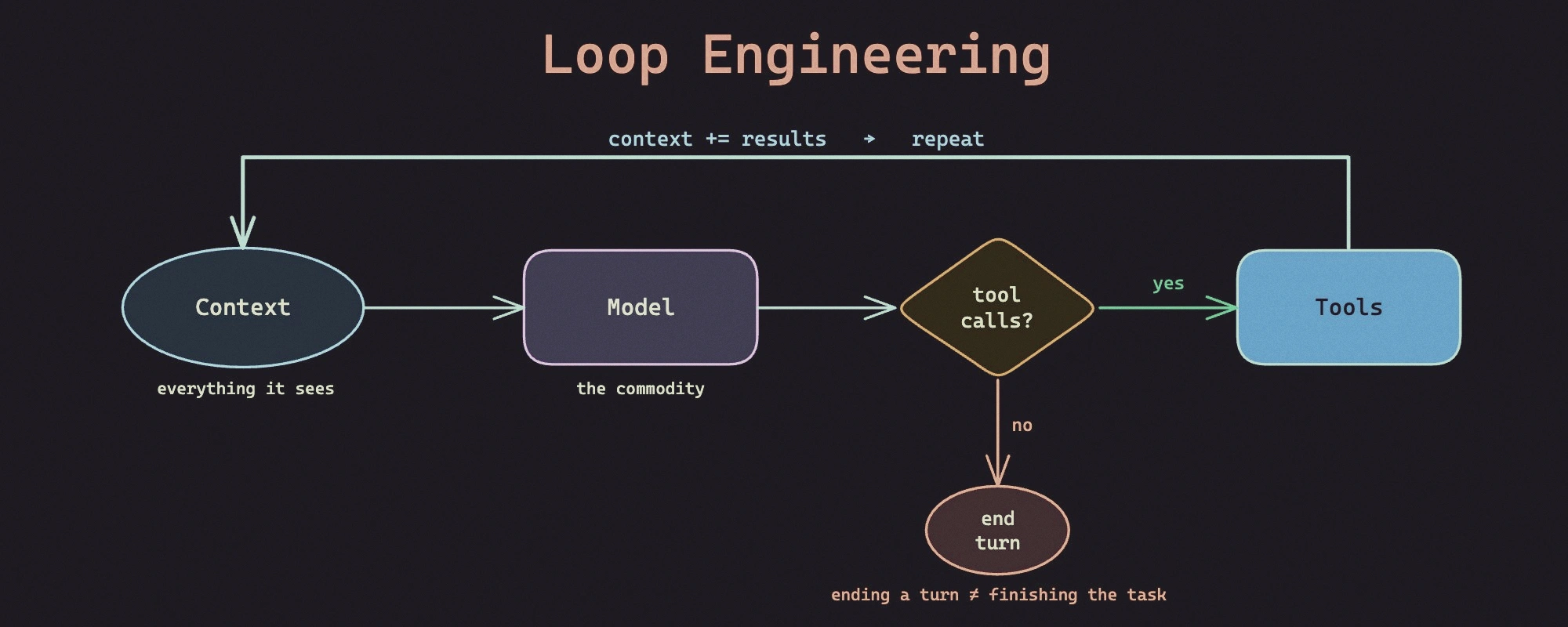
Loop Engineering is the practice of designing the work rhythm for an agent. Instead of giving it one long prompt and waiting for the result, you define a small loop: the agent receives a goal, uses a limited set of tools, produces an output, checks itself, then decides whether to stop or fix the result.
The key is to avoid treating an agent like someone who is "smart enough to figure it out." Think of it as a worker that needs rails. Those rails have four parts: a clear goal, clear limits, a clear output format, and clear criteria for what counts as good.
A good loop usually answers a few simple questions:
- What does done look like?
- Which sources, files, or tools can the agent use?
- When should the agent stop?
- What output counts as good enough?
- Who, or what step, checks the result?
The quick version: pick one small task this week, such as customer research, inbox triage, repo debugging, or summarizing internal documents. Do not start with the prompt. First write a five-line loop spec: goal, input, tools allowed, output required, and success criteria.
When the loop fails, the first thing to fix is usually not the model. If the output rambles, the goal is unclear. If the agent goes too far, the limits are unclear. If the result is hard to reuse, the output format is too loose. If the same mistake repeats, the loop is missing a check.
Short version: a prompt helps an agent understand a request. A loop helps an agent do that work repeatedly while keeping quality stable.
|
|
|
WORTH YOU TIME
ANALYSIS & RESEARCH WORTH EXPLORING
Microsoft's Work Trend Index frames AI adoption around readiness at both the individual and organizational level. It is a useful lens for Claude Tag: an agent in Slack only creates value if the culture, managers, governance, and work habits are ready to use it.
SemiAnalysis explores using AI agents to find compiler miscompiles. The piece shows a different side of agentic software work: when the task is hard, costly, and verifiable, agents can expand the scope of testing and search instead of merely speeding up code writing.
|
|
|
Have questions? Hit reply to this email and we'll help out!
600 1st Ave, Ste 330 PMB 92768, Seattle, WA 98104-2246
Unsubscribe · Preferences
|
|
|