|
Let’s take away what matters in AI every day and stay ahead with 50,000⁺ founders, builders, and tech readers.
|
|
|
BIG TECHAWAYS
WHAT MATTERS TODAY
- Anthropic has reportedly discussed a custom AI chip with Samsung, though the chip's design, role inside servers, and performance targets are still undecided. TechCrunch also notes that Anthropic continues to see a diversified hardware stack across Google, Amazon, and Nvidia as central to its compute strategy.
- This is not a chip launch story yet. The sharper signal is that frontier labs are starting to treat hardware control as part of model competition. When GPU supply, inference cost, and compute efficiency become strategic constraints, having more hardware optionality can matter almost as much as having a better model.
- Microsoft announced Microsoft Frontier Company, a new unit backed by a $2.5 billion commitment and 6,000 industry experts and engineers to help enterprises deploy AI using Microsoft's existing tools.
- That goes straight at the problem many companies are running into: they have models, Copilot, APIs, and AI tools, but turning those into real operating capability is still hard. Microsoft's bet is that the enterprise AI bottleneck is no longer access to models; it is making those models work inside the business.
|
|
|
SHIFT SIGNALS
THE SIGNALS BEHIND THE HEADLINES
AI took more than 70% of Q2 funding: Crunchbase says global venture funding hit $510 billion in the first half of 2026, with AI companies taking more than 70% of Q2 funding. Even as the market asks harder ROI questions, capital is still concentrating heavily around AI.
SoftBank wants to rent AI compute in the US: The Information says SoftBank plans to rent AI compute capacity to US companies. If that plays out, compute becomes a more layered rental market, not just a hyperscaler game.
Kling AI raised at least $2B ahead of a spin-off: Kling AI reportedly raised at least $2 billion as Kuaishou prepares to spin off the AI video unit. AI video is being valued less like an app feature and more like a capital-heavy platform category.
A famous account on Xsays much of the LLM TAM sits in coding, and much of that is waste: Dennis Hong argues that coding is most of the LLM TAM, but that many tokens are being burned generating bad code and redoing it. For builders, the real question is which workflows reduce rework and token waste.
The bear case on generative AI economics: Ed Zitron argues that generative AI lacks clear ROI measurement and that costs rise linearly with revenue. It is a useful counterweight to the Microsoft Frontier Company story: if AI deployment cannot prove economic value, the service layer around it will face pressure fast.
Chamath says enterprise AI needs a control plane: Chamath argues that enterprises should use a control plane, choose models per task, reduce cost, and avoid leaking their edge to frontier labs. That is the practical version of the ROI debate: do not always call the strongest model; route the right model to the right job.
Open-source AI is pressuring frontier lab business models: Dario Amodei's message is that open source, especially Chinese open-source models, could threaten AI business models. If open-source keeps improving while pushing prices down, frontier labs need to prove where their moat lives beyond model access.
Alexandr Wang teases the next Muse Spark update: Alexandr Wang says an upcoming Muse Spark update will improve coding and agentic capabilities to compete more directly with leading models. It is a small but useful signal that agentic coding competition is spreading beyond the familiar frontier labs.
|
|
|
AI IN ACTION
Treat your coding agent like a fast junior, not an autopilot
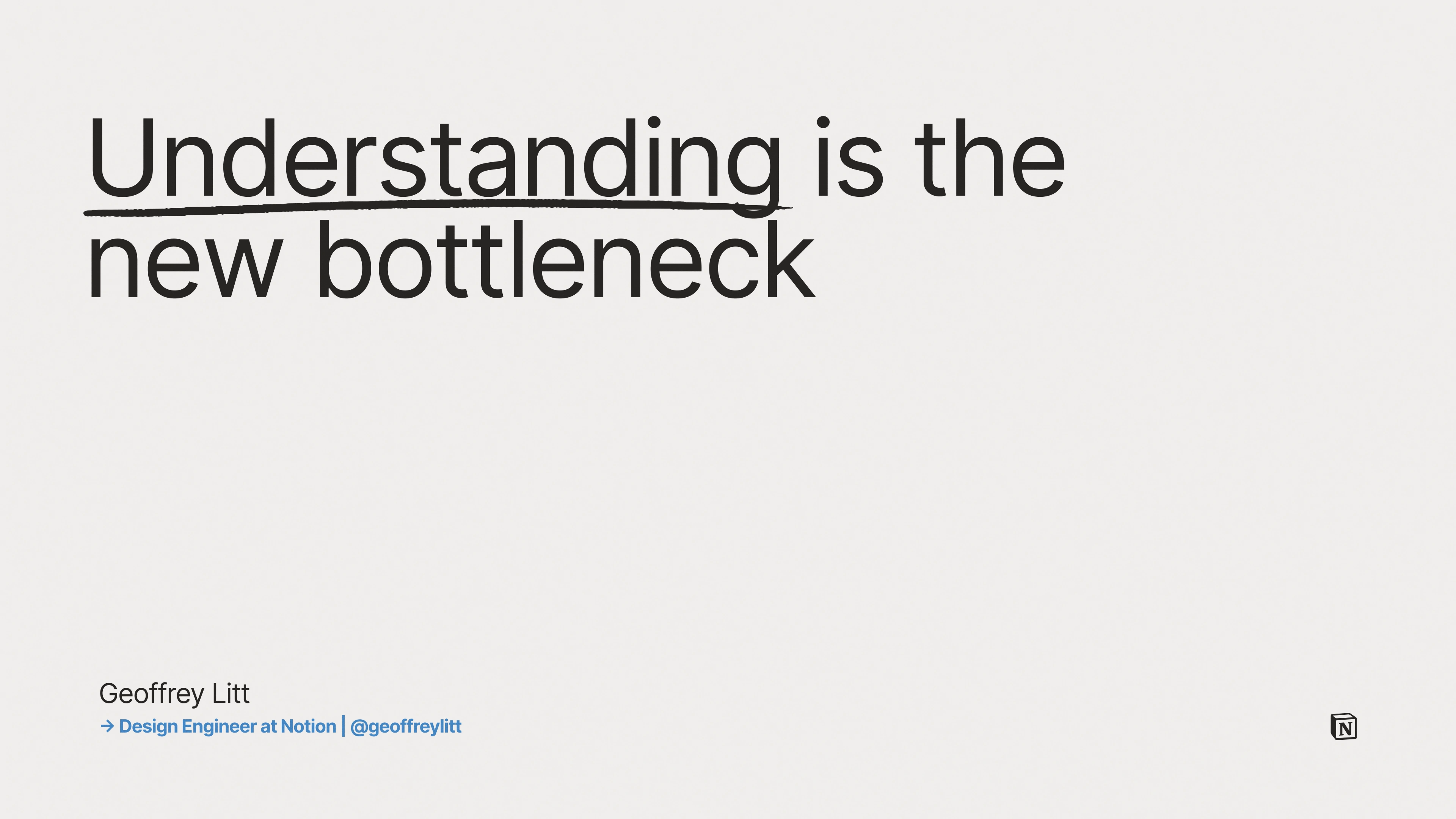
Simon Willison points back to a useful frame from Geoffrey Litt: when agents produce large, sophisticated changes, humans still need to understand the codebase well enough to participate. With vibe coding, the more durable habit is to treat the agent like a very fast junior. It can propose and fix a lot, but you still own the system’s mental model.
Try this in 30 minutes: before merging a large agent diff, make the agent defend its work the way a teammate would in review.
- Ask the agent to group the diff into three buckets: core logic, wiring/config, and tests or cleanup.
- For each bucket, ask: what was the original problem, why this fix, and what could still be wrong?
- Pick the most important path and read from the entry point into the new logic yourself.
- Run or inspect the relevant tests, then mark what has actually been verified.
- Write down the remaining risk in one short sentence before merging.
- If you cannot explain the flow back in your own words, the diff is not done.
Prompt you can use:
Review this diff like a teammate.
- Group the changes by purpose.
- Explain why each group was necessary.
- Name the most important assumption.
- Point out the easiest part to get wrong.
- Tell me which test/check proves the change works.
- Rewrite the new flow in five sentences so I can check whether I understand it.
How to read the result:
- If the agent explains in circles, the diff may be too wide.
- If the assumption is vague, ask it to split that part out or add a test.
- If you can understand the flow in five sentences, the review is moving in the right direction.
- If you trust it only because the agent says so, you are accumulating cognitive debt.
|
|
|
WORTH YOU TIME
ANALYSIS & RESEARCH WORTH EXPLORING
Stratechery looks at agents as a force that could reshape compute demand and where value lands in the AI stack. It is a useful read for connecting the pieces in today's issue: custom chips, compute rental, neoclouds, and deployment are all expressions of the same pressure.
SemiAnalysis digs into Oracle's position in the AI compute market. Read this if you want to understand why GPU cloud is becoming a strategic battlefield rather than just another cloud product line.
Crunchbase gives a data-backed view of how much venture capital is piling into AI. It balances the ROI skepticism running through the issue: investors may be asking harder questions, but AI is still where the biggest capital bets are going.
Simon Willison's note is a short, sharp read on a new risk: agents can produce code sophisticated enough that the human falls behind. For any operator using AI to build faster, speed only helps if you keep the ability to understand and change the system.
|
|
|
Have questions? Hit reply to this email and we'll help out!
600 1st Ave, Ste 330 PMB 92768, Seattle, WA 98104-2246
Unsubscribe · Preferences
|
|
|